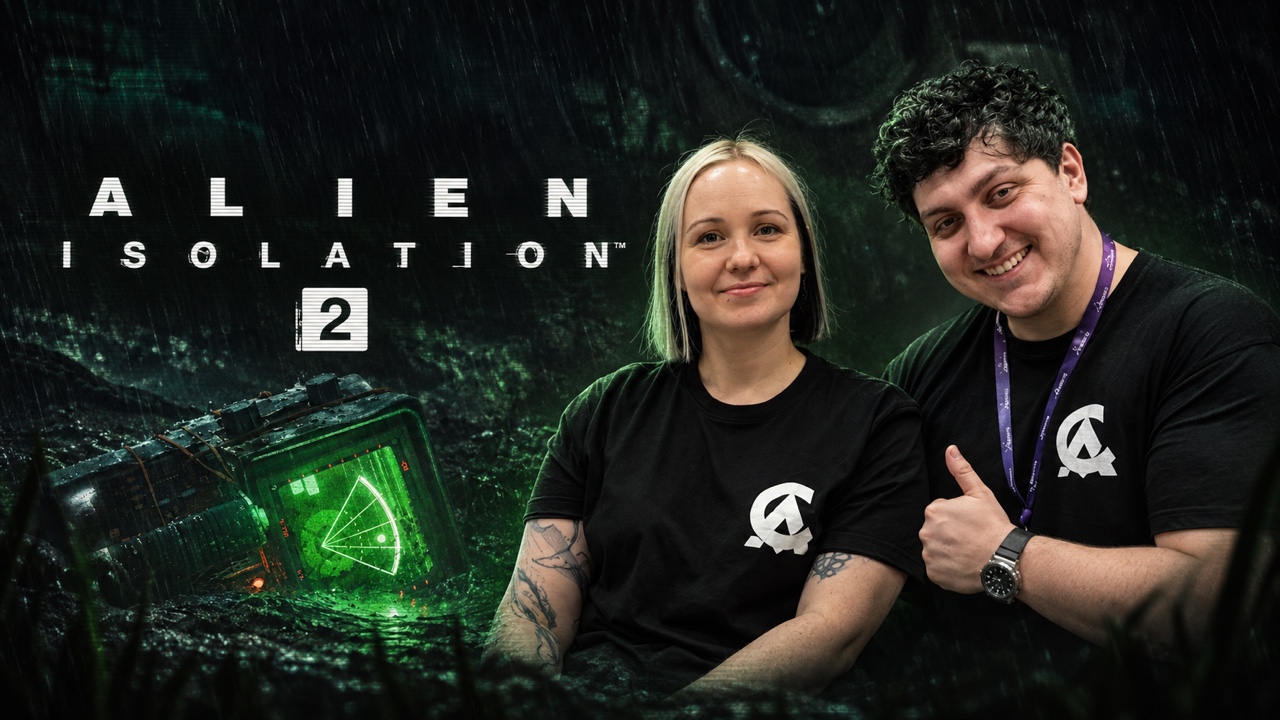

During Gamescom, we not only played the Alien: Isolation 2 demo but also had a chance to briefly interview Ana Sopikova (Art Director) and Archie Whitehead (Principal Environment Artist) from Creative Assembly.
How do you take the tension of Alien: Isolation beyond enclosed corridors? We spoke with the team working on the sequel about the creature’s behaviour, changing weather and why they want to preserve the intensity of the original game.
Alien: Isolation has developed a reputation as one of the best horror games ever made. Why is now the right time for a sequel? Was it the game’s growing reputation, a new generation discovering it, or something within Sega?
Ana: Our creative director Al Hope, who held the same role on the first game, always said he wanted to make a sequel, even before the original came out. That was always the intention. But things happened, and Sega had other projects they wanted to concentrate on. Now we feel the time is right, and we’re really happy we can finally bring it to people.
The original game became famous for its alien AI: one layer knew where the player was and fed hints to another. Is that architecture still the foundation, or have the more open environments required a different approach?
Ana: It is very much the same foundation. We feel that’s what made the first game so iconic, and it’s the core of the Isolation experience. The alien is unscripted. It uses its senses to track you: it can see you and hear you.
The outdoor environments add another layer. Inside, everything is claustrophobic and familiar. You can hear it in the vents, and you think you know what you’re doing and where you’re going. Then you go outside and think, “That’s fine. I can see. It’s more open, so maybe it’s safer.” But the weather changes, fog rolls in, and suddenly you can’t see more than a few metres ahead. Then it starts raining heavily, and you can’t hear your footsteps or the alien’s.
There are more variables affecting your experience and how you try to survive. They also affect how the alien hunts you. It’s a smart creature, and it will learn to hunt you outdoors slightly differently from how it does indoors.
But we’re not deviating from the formula. That’s what fans love and want more of. We’re taking the best parts, developing them and building on that foundation with exteriors and any new tools, features or gadgets we might have, while keeping the core as it was.
In the demo, my only encounter with the alien was inside the ship, but the opening journey through the rainy forest was unnerving. Can you give us a rough idea of how the final game divides its time between indoor and outdoor environments?
Ana: We’re still quite early in development, so I can’t give you numbers at the moment. We’re focused on delivering the best possible experience and making sure the pacing and flow support it.
It’s a narrative game, and a lot of what made Alien: Isolation successful was how well everything worked together to support the player’s emotions. You move through areas that look, sound and feel different. It’s no different in the sequel, except that exteriors give us an extra tool to use where we need it.
Ultimately, we want enough variety in both interior and exterior environments to support the player’s emotional journey and the gameplay. We’re also trying to cater for different playstyles. Some people like to hide in a locker and take a careful approach. The exteriors need to support that too, because it’s a valid playstyle.
Others like using gadgets, throwing noisemakers or flares. But if you throw a flare when it’s really windy, it might fly back into your face. What do you do then? It’s about bringing those elements together to support the story and the player’s journey.
Will it still be one creature hunting you, or could there be multiple aliens?
Archie: It’s very early. We reference the original film a lot as our guiding star. That film and the original game are about cat-and-mouse gameplay: the one-on-one relationship you have with the creature. That’s our focus.
Isolation is a game that many people love but never finish because it’s too frightening. Is getting players to finish something you optimise for, or is someone quitting in terror an acceptable outcome?
Ana: It’s an intense experience, and it isn’t going to be for everybody. We feel that’s okay: it’s a horror game. Everyone has a different tolerance for horror and difficulty. The original had multiple difficulty levels, and we’re going to support those too.
Sometimes it isn’t even about the gameplay. The music and ambience alone can really scare people. I’ve heard stories of people starting the first game, getting onto Sevastopol and being too frightened to proceed down a dark corridor with moody music, even though the alien doesn’t appear until later. There’s nothing we can really do about that from a difficulty perspective.
It isn’t an experience for everybody. But diluting it wouldn’t allow us to stay faithful to Ridley Scott’s original Alien. We’re definitely going to make it atmospheric and intense.
I had a similar feeling in the demo. I kept expecting the alien to appear in the forest. When I reached the shuttle, I briefly felt better because I assumed it would be inside.
Archie: It’s like the original film. You spend so much of it not seeing the alien, and even once it’s introduced, you barely see it. That’s one of the most powerful things about horror: it’s as much about what you don’t see as what you do.
The original Isolation was quite uncompromising. Do you think you can reach a wider audience with the sequel without having to make compromises? And what is essential for you to preserve?
Ana: I don’t think we want to compromise.
There are creative challenges in adapting Ridley Scott’s Alien aesthetic, which is based on a spaceship, and making it feel believable on a planet. But that’s a fun creative challenge. We didn’t want to take the same assets from the first game and simply put them on a planet.
We’ve spent a lot of time digging into the archives. We have a great relationship with 20th Century Games, who are very supportive, and access to the Fox archive: the same source materials used for the first game. That includes behind-the-scenes and close-up photography of the original film props. The team is studying the details and how those props were built.
That allows us to develop a set of techniques and a way of thinking about design, which we can apply to our own spaces on the planet. We want them to feel believable and natural. It’s a colony on a new planet we haven’t visited before in the Alien franchise, but it’s somewhere the Nostromo crew might have visited. It needs to belong in that universe.
Archie: That’s why we wouldn’t want to dilute what fans love about the original. Authenticity is so important to us. We want people who love this franchise and horror games to get what they came for.
How does the entirely new setting of a dense forest change the way the alien moves and hunts outdoors? Does it present any obstacles for the creature?
Ana: It’s still early in development, and we’re working out what biome best suits the planet. We want it to feel believable and not distracting. We don’t want players asking why a tree looks a certain way or why a plant is strange. The alien is meant to be the only extraordinary thing. Everything else supports immersion.
I’m sure the alien will have no problem traversing anything. It is the perfect organism, after all.
Our approach starts with believability. If this is the weather we want on the planet, what plants would thrive there? What biomes would we see in that climate in the real world? We don’t want it to look unnatural. Even if you don’t consciously think about it, something that feels off can affect your perception and make you feel less immersed. We’re building a stage for the creature. Everything has to support and elevate it.
You’re using Unreal Engine 5 and developing your own lighting and audio systems. What did you need to build yourselves?
Archie: One of the great things about Unreal is that it provides pretty much everything you need to make a game. It’s a really strong platform. But we identified two things that are particularly important for horror: lighting and audio.
The original won a number of awards for its audio, and that’s something we didn’t want to compromise on. The audio director and lead sound designer worked on the original, so they’re bringing that experience with them.
It’s not that Unreal didn’t provide those things. We wanted something specific that would let us execute them at the highest level we could for our game. We felt we could do that best by building our own systems to do exactly what we wanted. We also have many developers with extensive Unreal experience, in some cases decades, who can get the most out of it.
Great, thank you both for the interview. We’re looking forward to the Isolation sequel.
Both: Thank you!
This interview has been edited for length and clarity.